
Fluid Level and Dynamometer Testing Equipment
For Oil and Gas Wells

This rugged system prints the fluid level and well reflections as a graph on thermal paper tape, overlaid with 1-second precision timing marks to aid in fluid level calculation. Microprocessor based, multi-channel recorder with automatic gain control, analog to digital converter, thermal printer and embedded signal acquisition software. No computer required.
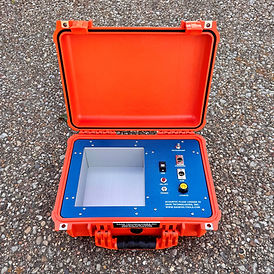
This compact acoustic well sounder works with your field computer, allowing you to save and email digitalized fluid level shots. Software uses gathered data to produce a graph of the fluid level pick, as well as calculated pump intakepr essure, bottom hole pressure and available production increases, which is compiled into a well analysis report with fluid level diagrams.

The Sage Acoustic Fluid Logger AFL V is a reliable and efficient wireless solution for determining the distance from the wellhead to the fluid level in the casing annulus of oil and gas wells. Utilizing advanced acoustic technology, the system delivers fast, accurate, and non-invasive fluid level measurements that are essential for well diagnostics and production optimization. Designed for field use, the AFL V combines robust hardware, wireless data acquisition, and powerful diagnostic software in a compact, easy-to-use system.


Pressure Pulse Gas Gun 3000 psi
The 3000 psi pressure pulse gas gun has a volume chamber that can be isolated from the well by a plunger valve. The chamber is charged with CO2 or nitrogen at a pressure greater than the pressure in the wellbore. When the level gun is triggered, the plunger valve rapidly opens. A pressure pulse travels down the well and echoes from the fluid level (explosion). A microphone in the gas gun senses the echo and converts it into an output signal. Alternatively, gas from the wellbore may be vented into the volume chamber (implosion), causing a negative pressure.
Pressure Pulse Gas Gun 5000 psi
The 5000 psi pressure pulse gas gun has a volume chamber that can be isoloted from the well using an integrated ball valve. When connected to the casing or tubing flowline, gas from the wellbore can be vented into the chamber by quickly opening and closing the ball valve. This creates a negative pressure pulse, or implosion, that travels down and back up the well. A microphone senses the shot and echoes and converts them into 4 to 20 mA output signals. While an external gas source is not necessary, a wellhead pressure of 50 to 100 psi is required.

